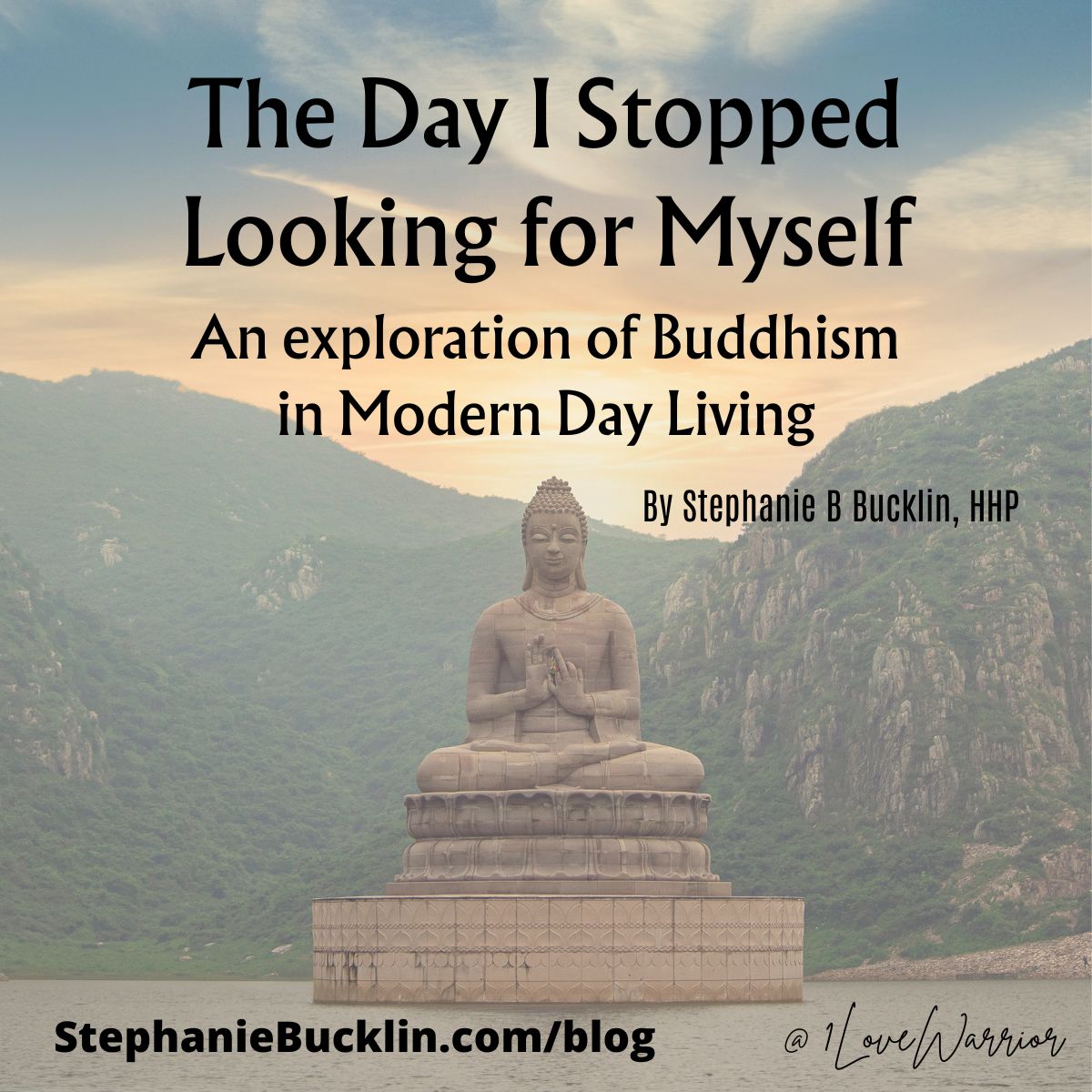
An exploration of Buddhism in Modern Day Living
By Stephanie B Bucklin, HHP
For much of my life, I believed healing meant becoming a better version of myself.
A stronger self. A wiser self. A more awakened self. But as I have peeled back the layers of suffering – the trauma, the identities, the stories, the wounds, and even the healing itself – I have discovered something surprising:
- There was never a fixed self underneath any of it.
- There is simply awareness.
- There is presence.
- There is awakening.
In the language of Buddhism, this is called anattā, or non-self. And perhaps the most radical teaching of the Buddha is this:
“Nothing whatsoever should be clung to as ‘This is mine, this I am, this is my self.’” — The Buddha, Majjhima Nikāya
The Origins of Non-Self
More than 2,500 years ago, Siddhartha Gautama sat beneath the Bodhi tree and awakened to the nature of suffering. He observed that everything changes:
- Thoughts change.
- Emotions change.
- Bodies change.
- Relationships change.
- Even our personalities change.
If everything changes, then what exactly are we calling “me”?
The Buddha taught that what we call a person is actually a collection of processes known as the Five Clinging Aggregates:
1. Body (form)
2. Feeling
3. Perception
4. Mental formations
5. Consciousness
Together they create the experience of being someone, but none of them, individually or collectively, are a permanent self. This teaching was never intended to be depressing. It was intended to be liberating. Because if there is no permanent self to defend, then there is nothing to lose.
How Suffering Is Created
I can see this clearly in my own life. I suffered when I identified myself as a successful business owner. I suffered when I identified myself as someone’s partner. I suffered when I believed I was my trauma. I suffered when I believed I was broken.
Each identity became another thing to protect – another thing to lose, another source of fear.
The Buddha saw this thousands of years ago:
- Identification becomes craving.
- Craving becomes attachment.
- Attachment becomes fear.
- Fear becomes suffering.
Identification → Craving → Clinging → Fear → Suffering
As teacher Jack Kornfield writes: “If your compassion does not include yourself, it is incomplete.”
The journey isn’t to destroy ourselves. The journey is to stop clinging to the stories that imprison us.
The Three Marks of Existence
Buddhism teaches that all conditioned things share three qualities:
- Impermanence (Anicca): Everything changes.
- Suffering or Unsatisfactoriness (Dukkha): When we demand permanence from an impermanent world, we suffer.
- Non-Self (Anattā): There is no separate, permanent entity controlling the experience. There is only experience unfolding.
As the Greek philosopher Heraclitus said: “No man ever steps in the same river twice.”
The Middle Way
The Buddha rejected two extremes. One says there is an eternal, unchanging soul. The other says nothing matters because everything disappears. Instead, he taught a Middle Way. Life is a process…. A river…. A continuous unfolding of causes and conditions.
Zen teacher Thich Nhat Hanh called this interbeing: “We are here to awaken from the illusion of our separateness.”
As a psychic medium, healer, and spiritual teacher, I have come to experience this truth deeply.
- I do not experience myself as separate from God.
- I do not experience myself as separate from you.
- I experience myself as consciousness expressing itself through this human life.
Awake. Present. Connected. The Buddha within.

What Does This Look Like in Modern Life?
Non-self isn’t just philosophy. It is practical.
- When someone criticizes us, we don’t have to defend an identity.
- When we lose a job, we don’t lose ourselves.
- When a relationship ends, our being remains untouched.
- When we age, our essence has not diminished.
Modern mindfulness practices, nervous system regulation, meditation, and even trauma healing often point toward the same truth:
You are not your thoughts. You are not your emotions. You are not your trauma. You are the awareness in which all of these experiences arise and pass.
As Eckhart Tolle writes: “The primary cause of unhappiness is never the situation but your thoughts about it.”
The Noble Eightfold Path: Ancient Wisdom for Modern Living
The Buddha never intended the Eightfold Path to be a rigid checklist or religious doctrine. It is a lifelong practice – a way of relating to ourselves, others, and the world that gradually frees us from unnecessary suffering. Each “limb” of the path supports the others. As we practice one, we naturally strengthen the rest.
1. Right View (Sammā Diṭṭhi)
Seeing Clearly
Right View is the foundation of the entire path. It asks us to see reality as it is rather than as we wish it to be. This means recognizing that everything is impermanent, our actions have consequences, and much of our suffering comes not from life itself but from our resistance to it.
In modern life, Right View looks like:
- Accepting difficult situations instead of denying them.
- Distinguishing facts from the stories our minds create.
- Recognizing cognitive distortions and challenging limiting beliefs.
- Understanding that emotions are temporary visitors rather than permanent truths.
- Viewing setbacks as opportunities for growth rather than evidence of failure.
Example:
You don’t receive the promotion you hoped for. Rather than telling yourself, “I’m not good enough,” Right View encourages you to ask, “What is actually true in this moment? What can I learn from this?”
“The root of suffering is attachment to the way things should be rather than accepting the way they are.”
2. Right Intention (Sammā Saṅkappa)
Choosing Compassion Over Ego
Every action begins with an intention. Right Intention invites us to act from kindness, generosity, forgiveness, and wisdom instead of fear, greed, or anger.
In modern life this means:
- Pausing before reacting emotionally.
- Choosing understanding over judgment.
- Practicing forgiveness without excusing harmful behavior.
- Releasing resentment that only harms ourselves.
- Setting intentions each morning for how we wish to show up.
Example:
Before entering a difficult meeting, you silently remind yourself: “May I respond with clarity, kindness, and courage.”
Instead of trying to win, you seek understanding.
3. Right Speech (Sammā Vācā)
Speaking Truth with Compassion
Words have the power to heal or wound.
The Buddha encouraged speech that is:
- truthful
- kind
- beneficial
- timely
Before speaking, ask:
- Is it true?
- Is it helpful?
- Is it necessary?
- Is it kind?
Modern practice includes:
- Avoiding gossip.
- Speaking honestly in relationships.
- Listening more than speaking.
- Setting healthy boundaries respectfully.
- Being mindful of what we post on social media.
Example:
Instead of writing an angry text while upset, you wait until you’re calm and communicate your feelings honestly without attacking the other person.
4. Right Action (Sammā Kammanta)
Living Your Values
Our actions reveal our character more than our intentions. Right Action encourages ethical living through compassion and respect for all life.
Modern examples include:
- Keeping your promises.
- Respecting others’ boundaries.
- Caring for your physical health.
- Treating animals and the environment with kindness.
- Acting with integrity even when no one is watching.
Example:
Returning extra change a cashier accidentally gave you, even though no one would have known.
Integrity becomes who you are—not what you do when others are watching.
5. Right Livelihood (Sammā Ājīva)
Aligning Your Work with Your Values
The Buddha taught that our work should contribute to well-being rather than harm.
Today’s interpretation asks: “Does my work align with the person I wish to become?”
Modern examples include:
- Choosing careers that help rather than exploit.
- Building ethical businesses.
- Treating employees and customers fairly.
- Creating products that improve people’s lives.
- Refusing work that violates your deepest values.
For many of us, this may mean earning less while living with greater integrity.
Example:
Choosing meaningful work that nourishes your spirit over a higher-paying position that compromises your ethics.
6. Right Effort (Sammā Vāyāma)
Cultivating Healthy Habits
Right Effort is not about striving or perfection. It is about consistently nourishing what is healthy while gently letting go of what creates suffering.
Modern practice includes:
- Developing healthy routines.
- Limiting doomscrolling and excessive social media.
- Exercising regularly.
- Maintaining healthy sleep habits.
- Practicing gratitude.
- Replacing self-criticism with self-compassion.
Rather than asking, “How do I become perfect?”
Right Effort asks, “What small choice can I make today that supports peace?”
7. Right Mindfulness (Sammā Sati)
Being Fully Present
Mindfulness is perhaps Buddhism’s best-known gift to modern psychology. It means paying attention to the present moment without judgment.
Instead of living on autopilot, we become aware of our:
- thoughts
- emotions
- physical sensations
- habits
- reactions
Modern practices include:
- Meditation.
- Mindful breathing.
- Yoga.
- Journaling.
- Eating without distractions.
- Walking in nature.
- Fully listening during conversations.
Example:
Rather than scrolling your phone while eating dinner, you notice the taste, texture, aroma, and gratitude for your meal.
Presence transforms ordinary moments into sacred ones.
8. Right Concentration (Sammā Samādhi)
Developing Inner Stillness
In today’s world, our attention is constantly fragmented. Notifications, emails, social media, advertising, and endless stimulation keep the mind scattered. Right Concentration is the practice of training the mind to rest deeply.
Modern practices include:
- Daily meditation.
- Breathwork.
- Prayer.
- Silent retreats.
- Spending uninterrupted time in nature.
- Deep creative flow while writing, painting, gardening, or making music.
As concentration deepens, clarity naturally follows. Instead of reacting impulsively, we respond from wisdom. Stillness becomes less something we seek and more something we carry within us.
Living the Path Today
The Noble Eightfold Path isn’t about becoming a perfect Buddhist. It is about becoming a more conscious human being.
Every mindful breath…
Every honest conversation…
Every compassionate choice…
Every moment of forgiveness…
These lifestyle practices are the path.
As I reflect on my own healing journey, I realize I have not been practicing the Eightfold Path because someone told me I should. I discovered Buddhism as a young adult looking for true spirituality in a JudeoChristian world. I have been living Buddhism because, through suffering, I discovered that these principles naturally lead to greater peace. They have helped me move from reacting to responding, from fear to trust, from clinging to surrender, and from searching for happiness outside myself to discovering the quiet awareness that has always been present.
Perhaps enlightenment is not a distant destination reserved for monks or mystics. Perhaps it is found in the ordinary moments of everyday life—when we choose truth over illusion, compassion over judgment, and presence over distraction. Each small choice is a step on the path, and each step brings us home to ourselves… or perhaps, in the Buddha’s radical teaching, beyond the very idea of a separate self.
The path is not about becoming perfect. It is about awakening to what has always been here.
I Am Awake
As I continue to unravel the layers of suffering, I find something unexpected. I do not find a permanent self. I find stillness. Awareness. Presence. Compassion.
I find what the Buddhists call Buddha Nature.
Perhaps enlightenment is not becoming someone new. Perhaps it is simply remembering what we have always been. Awake.
~S
Ready to Experience Unshakable Inner Peace?
Reading about peace is inspiring. Living it is transformational.
The Unshakable Inner Peace™ Program is a guided journey designed to help you release fear, regulate your nervous system, cultivate mindfulness, and build a foundation of lasting inner peace. Drawing from Buddhist philosophy, neuroscience, trauma-informed healing, mindfulness practices, and modern psychology, this program offers practical tools you can begin applying immediately to your everyday life.
Whether you’re navigating anxiety, grief, burnout, life transitions, or simply longing for a deeper connection with yourself, this program provides a compassionate roadmap back to the peace that has always existed within you.
✨ Not sure where to begin?
Schedule a complimentary Discovery Call with Stephanie to explore your goals, ask questions, and determine whether the Unshakable Inner Peace™ Program is the right next step on your healing journey.
Your peace isn’t something you have to earn. It’s something you can remember.
Take the first step today. 💜