
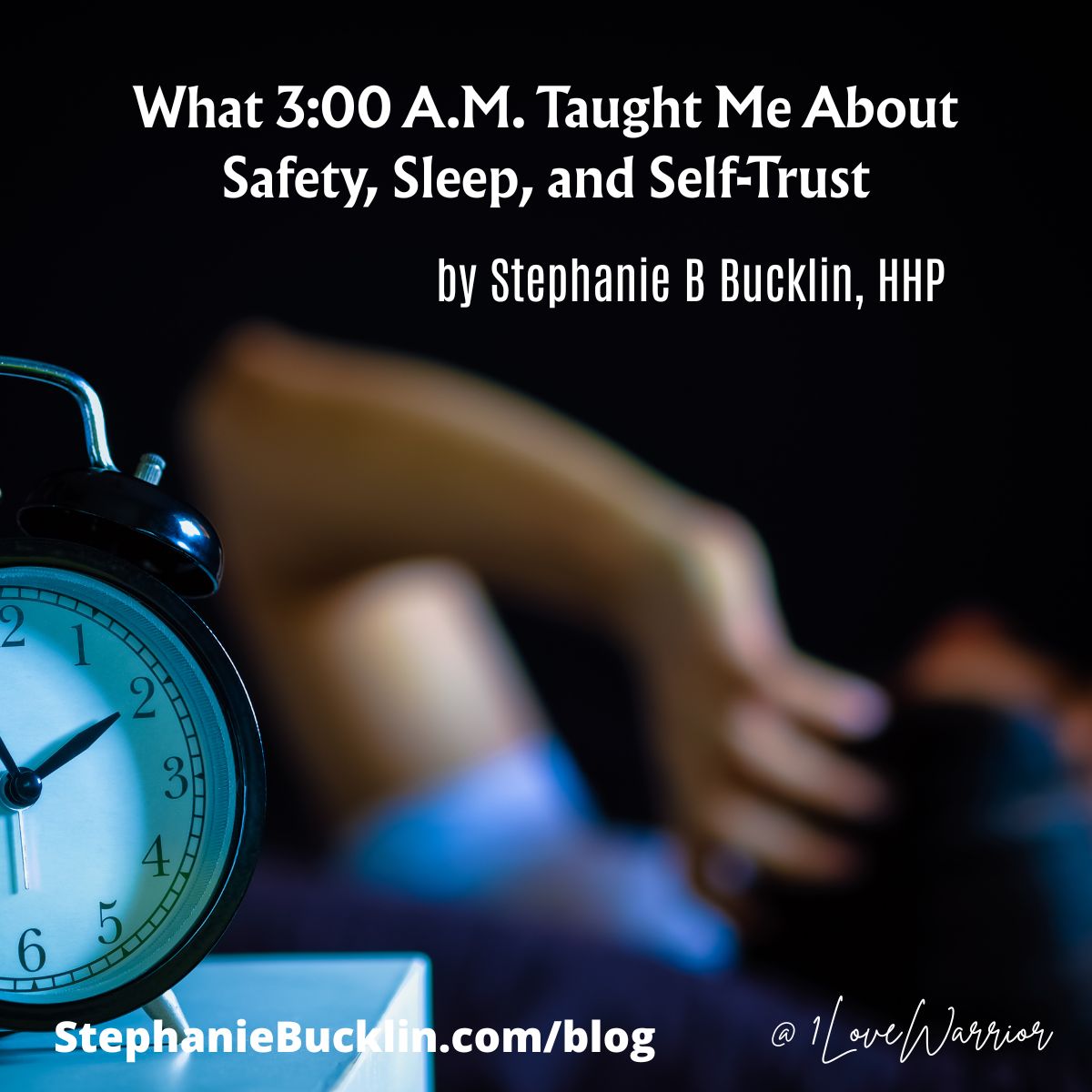
by Stephanie B Bucklin, HHP
It’s 4:00 a.m. as I write this. My little dog woke me up.
I tried one of my nervous system regulation tools and settled back into bed. Then my mind started moving. I picked up my phone. A reel on social media touched something deep inside me and suddenly I was crying. My body heated up. I kicked off the blankets. My nervous system was activated again.
And there I was—awake in the middle of the night, having a conversation with myself about safety.
Yesterday, I was teaching a workshop on Nervous System Regulation Tools. During the presentation, I said something that felt profoundly true:
“If you have insomnia, it helps to have nervous system regulation tools because often it’s the body that’s keeping us awake. It’s all about safety. If you can tell your body that you’re safe, it will settle down.”
Now, in the early hours of the morning, I was being asked to practice what I teach.

The Body Doesn’t Speak English
One of the challenges of insomnia is that we often try to think our way back to sleep:
- We negotiate: if I fall asleep now I’ll get XX more hours before I have to get up.
- We reason: my body and mind need rest – why can’t I sleep?
- We tell ourselves we need to sleep: I don’t want to be tired all day tomorrow!
But the nervous system doesn’t respond primarily to logic – it responds to safety.
Dr. Stephen Porges, creator of Polyvagal Theory, explains that our nervous system is constantly evaluating whether we are safe, in danger, or under threat through a process he calls “neuroception.” This evaluation often occurs beneath conscious awareness.
You may consciously know that you’re safe in your bed, but your body may disagree.
The body remembers stress differently than the mind does.
- A difficult conversation.
- A financial concern.
- A relationship issue.
- A health challenge.
- A disturbing dream.
- Even a challenging movie, TV show or reel you watched.
Sometimes all it takes is waking up unexpectedly at 3:00 a.m. for the nervous system to begin scanning for problems.
The Hidden Cost of Chronic Insomnia
Most people think insomnia is about being tired. But chronic insomnia affects far more than our energy levels. Sleep deprivation impacts concentration, emotional regulation, decision-making, memory, immune function, pain perception, and stress resilience.
When we consistently fail to get restorative sleep, we often become less patient, less emotionally flexible, and more reactive. Everything feels harder.
The challenge is that insomnia itself can become a habit loop.
- Wake up.
- Check the phone.
- Think about tomorrow.
- Review the past.
- Worry about the future.
- Get frustrated about being awake.
Each step teaches the body that being awake at 3:00 a.m. is a time for activation rather than restoration. I know this pattern because I’ve lived it. Writing blog posts at 4:00 a.m. might be productive – I’ve told myself if this is when inspiration hits, it’s ok to follow it. But is it what my body needs? That’s a different question.
Healthy Boundaries Aren’t Just About Other People
When we talk about boundaries, we often think about relationships.
- Saying no.
- Protecting our time.
- Limiting access to our energy.
But healthy boundaries also apply to ourselves. Sometimes the boundary isn’t with another person – sometimes the boundary is with our own behavior.
The boundary might sound like:
- “No, I’m not opening social media right now.”
- “No, I’m not solving tomorrow’s problems at 3:00 a.m.”
- “No, I’m not replaying that conversation again.”
- “No, I’m not abandoning my body’s need for rest.”
Self-love is often less glamorous than we imagine. Sometimes self-love is putting the phone down. Sometimes self-love is taking three slow breaths. Sometimes self-love is allowing unfinished things to remain unfinished until morning.
Teaching the Body That We Are Safe
The beautiful thing about nervous system regulation is that it doesn’t require perfection, it requires practice.
- Every time we pause and breathe, we send a message.
- Every time we soften our jaw, relax our shoulders, or lengthen our exhale, we send a message.
- Every time we choose self-compassion over self-criticism, we send a message.
The message is simple: “I am safe.”
Polyvagal researchers note that feelings of safety are associated with autonomic states that support restoration, growth, healing, and access to higher-order thinking. When we feel safe, we gain greater access to creativity, problem-solving, and connection.
This is why nervous system work matters. Not because we’re trying to eliminate every difficult feeling. Because we’re teaching the body that it no longer needs to remain on high alert.
The Journey Beyond Survival
One of my favorite insights from nervous system work is that healing isn’t about becoming calm all the time. Deb Dana writes that resilience involves the ability to move flexibly between states and return to regulation when activated. That feels more realistic to me. This is a practice and the goal isn’t perfection..
- Life will activate us.
- Dogs will wake us up.
- Relationships will challenge us.
- Unexpected expenses will arise.
- We’ll cry over social media reels at 4:00 a.m.
The goal is finding our way back. Each time we return, we build trust. Each time we return, we deepen our sense of safety. Each time we return, we teach the body that we can survive discomfort without becoming lost in it. And eventually something beautiful happens.
The energy that was once spent on survival becomes available for creation.
- For writing.
- For speaking.
- For teaching.
- For service.
- For purpose.
- For becoming.
Tonight, as my eyes grow heavy and sleep begins to return, I’m reminded that healing isn’t one dramatic moment.
It’s thousands of tiny moments.
A breath.
A pause.
A choice.
A boundary.
A reminder to the body:
“We’re safe now.”
And sometimes that’s enough to help us drift back to sleep.
~S
Are you tired of carrying pain, stress, and old wounds all by yourself?
Holding Myself Through the Truth: A Trauma-Informed Reflection on Emotional Abuse and Self-Healing is my most personal book yet—a compassionate invitation to understand your nervous system, honor your experiences, and begin rebuilding trust with yourself.
Through stories of trauma, healing, and resilience, I share the tools and insights that helped me move from survival into self-compassion and inner peace.
If this blog resonated with you, I invite you to continue the journey.
✨ Learn how to hold yourself through difficult emotions.
✨ Discover practices for nervous system regulation and self-trust.
✨ Remember that healing doesn’t require perfection—only a willingness to return to yourself with love.
Your healing matters. Your story matters. And you deserve to feel safe within yourself again.
📖 Holding Myself Through the Truth is available now on Amazon in Kindle and paperback formats.
With love and compassion,
Stephanie Bucklin
Author, Holistic Health Practitioner & Guide for Self-Healing 🌿💜

One response to “What 3:00 A.M. Taught Me About Safety, Sleep, and Self-Trust”
Great content! Keep up the good work!